Redis + Websockets + Tic-Tac-Toe
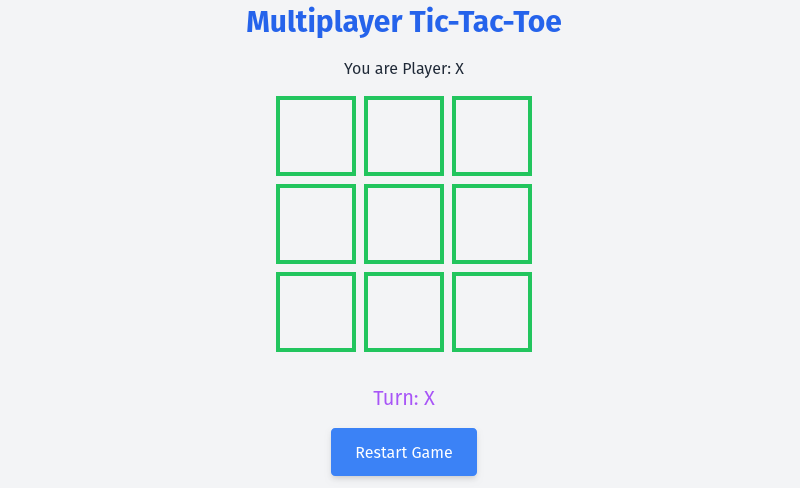
This project is a real-time multiplayer Tic-Tac-Toe game designed to explore and implement modern communication technologies. It provides a seamless experience where two players can compete against each other in real time, with every move instantly synchronized across their browser windows. The project demonstrates the use of WebSockets and Socket.IO for real-time communication, along with Redis as a shared state management system.
Core Components
At its heart, the project is divided into three main components: the backend, the frontend, and Redis for shared state storage.
Backend: The Game Server
The backend acts as the brain of the game, ensuring that players stay in sync and the game logic is executed correctly. It tracks the state of the game, such as the board layout, turn order, and determining when a player has won or when the game ends in a draw. Communication between the backend and the players happens in real time, either through raw WebSocket connections or the Socket.IO library. Redis is used to persist and synchronize the game state, making it resilient to crashes or restarts while maintaining a consistent experience for the players.
Frontend: The Player Interface
The frontend is where players interact with the game. It provides a simple and intuitive interface to make moves, see whose turn it is, and view game results such as a win, loss, or draw. It seamlessly communicates with the backend, sending player actions like move selection and receiving updates to reflect the game state in real time.
Redis: The Shared State Manager
Redis serves as the shared memory for the backend, acting as a centralized place to store the game state. This ensures that even if the server restarts, the game state remains intact. Redis also enables efficient broadcasting of updates to all players by leveraging its Pub/Sub functionality.
WebSockets in Action
WebSockets play a critical role in this project, providing a persistent, full-duplex communication channel between the client and the server. Unlike traditional HTTP, which relies on a request-response cycle, WebSockets allow data to flow continuously in both directions, making it perfect for real-time applications like this multiplayer game.
Establishing the Connection
The WebSocket connection starts with an HTTP upgrade request. Once the handshake is complete, a persistent connection is established, enabling the server and client to communicate without the overhead of repeated HTTP requests.
Communicating Messages
The server processes player actions, such as making a move or restarting the game, and broadcasts the updated game state to all connected clients. The communication is structured using a lightweight JSON-based protocol, ensuring clarity and simplicity. For instance, a player making a move might send a message like { type: "makeMove", data: 3 }.
Broadcasting Updates
When a significant event occurs, such as a player winning or making a move, the server broadcasts the updated state to all connected clients. This ensures that both players have an up-to-date view of the game at all times.
Implementing WebSockets from Scratch
This project also delves into the raw implementation of WebSockets to provide a deeper understanding of the protocol.
On the server side, the WebSocket handshake is handled manually through an HTTP upgrade request, after which the server maintains a list of connected clients. Messages are parsed and broadcasted by encoding them into WebSocket frames, ensuring that each client receives the necessary updates.
On the client side, a WebSocket connection is established to the server, and messages are exchanged in real time. Players’ actions are encoded as JSON messages, sent to the server, and then reflected on the game board through server updates.